Why Two Chicago Medical Assistants Earn Very Different Salaries
Why Two Chicago Medical Assistants Earn Very Different Salaries
A medical assistant salary is a range, not a single figure. Nationally the Bureau of Labor Statistics reports a spread from roughly $36,050 at the low end to about $59,310 at the high end, with the midpoint near $45,690 — and where a Chicago role lands in that range depends on the employer, the credential, and how many years are behind you.
According to the U.S. Bureau of Labor Statistics, the median annual wage for medical assistants was $45,690, with employment projected to grow 13 percent from 2025 to 2035 — much faster than the average for all occupations (U.S. Bureau of Labor Statistics, Occupational Outlook Handbook, May 2025).
Most salary articles quote the midpoint and stop. This one walks the whole range, because the midpoint is the least useful number in it if you are deciding whether to train.
Key Takeaways
- BLS reports roughly $36,050 at the low end and $59,310 at the high end, with a $45,690 median — a spread of more than $23,000.
- The lowest figures generally describe first jobs; the highest generally describe experienced medical assistants in demanding settings.
- Chicago’s employer mix — large hospital systems, community health centers, and independent practices — is the biggest single reason two local postings differ.
- The CCMA credential is what most Chicago clinical postings screen for; Illinois does not license medical assistants.
Read the Range, Not the Midpoint
A median means half of medical assistants nationally earn more and half earn less. It blends every state, every setting, and everyone from a first-week hire to a twenty-year veteran into one number, which is why it describes almost nobody precisely.
The endpoints are more informative. The low end is roughly what a first clinical job looks like before you have a track record. The high end generally belongs to experienced medical assistants who have specialized, taken on responsibility beyond rooming patients, or work in settings that pay for difficulty — nights, weekends, high-acuity care.
Neither endpoint is a promise. They are the observed boundaries of a national distribution, and they are useful mainly as a map of where the road goes.
Chicago’s Employer Mix Is the Biggest Variable
Chicago’s outpatient care is not one market. It is at least three, and they hire differently.
Large hospital systems run extensive outpatient networks across the city and suburbs. These roles tend to come with structured pay bands, formal job levels, and defined paths between them. The structure cuts both ways: less negotiating room at entry, clearer steps afterward.
Federally qualified health centers and community clinics serve much of Chicago’s South and West Sides. The work is high-volume, broad-scope, and often the fastest place to build a complete skill set, because a small team covers everything.
Independent and specialty practices — dermatology, cardiology, orthopedics, pediatrics — narrow the daily skill list and go deeper on it. They frequently want someone already fluent in the procedures that practice performs all day.
A posting from each of these three will read differently and pay differently, for the same job title.
What First-Year Roles Usually Look For
At the entry end, employers are buying competence at clinic tempo. Can you room a patient efficiently, take accurate vitals, draw blood without a second attempt, and chart it correctly before the next patient is waiting?
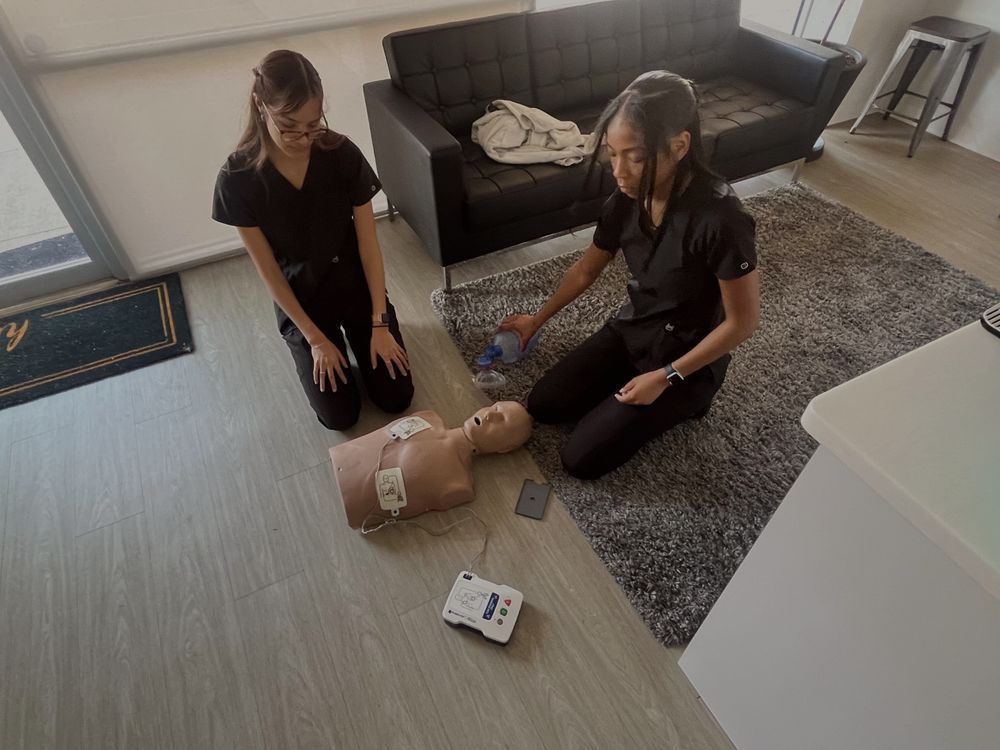
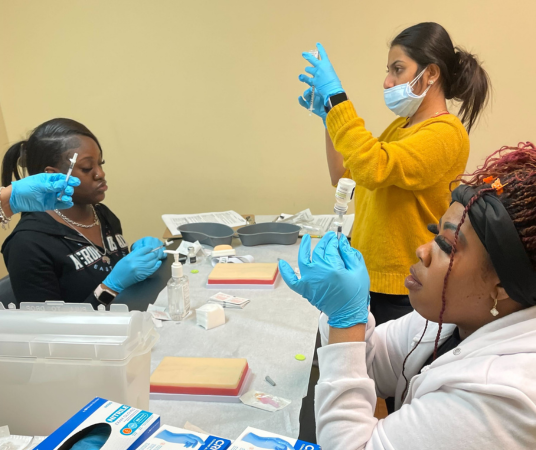
That is why hands-on repetition matters more than coursework hours. At Chicago Medical Assistant School the program is 18 weeks and hybrid: coursework online during the week, plus one 4.5-hour lab every Saturday inside a working medical office. Students practice venipuncture and order of draw, electrocardiograms, injections and medication administration, urinalysis and rapid testing, infection control and wound care, and electronic health record charting.
Tanisha spent eight years in retail management in Bronzeville and had never handled a needle. The Saturday labs are where that changed — not on the first draw, but somewhere around the fifteenth.
What Distinguishes Roles Further Along the Range
The gap between the entry figure and the median is mostly time and proof. Medical assistants who have been in a practice a few years tend to take on work that newer hires do not: training new staff, managing a specific provider’s patient panel, handling prior authorizations and referrals, or owning a procedure the office performs constantly.
Postings that describe those responsibilities are written for a different candidate than postings that list only core clinical duties. Reading enough Chicago listings will show you the pattern quickly.
What the Top of the Range Usually Describes
The high end of the BLS spread is not a typical Chicago job, and it is worth being clear about that. Those figures generally reflect experienced medical assistants in specialized or demanding environments — settings with unusual skill requirements, shift differentials, or supervisory elements folded into the role.
Treat it as the ceiling of the occupation as measured nationally, not as a target you should expect to reach on a schedule.
What Illinois Requires — and What It Doesn’t
Illinois does not license or register medical assistants. There is no state credential you are legally required to hold to work as one.
The requirement comes from employers instead, and on clinical postings across Chicago it is close to universal. Practically, the NHA Certified Clinical Medical Assistant credential functions as a screening line — it determines which postings will consider your application at all. Because a supervising physician delegates clinical tasks under their own authority, verify any specific scope-of-practice question with the employer and the relevant Illinois board rather than assuming the credential settles it.
Graduates of Chicago Medical Assistant School receive a certificate of completion and a BLS (CPR) card, and hold the CCMA credential once they pass the NHA exam.
Training in Chicago: What the 18 Weeks Require
Two campuses run the program: Lincoln Park on West Diversey Parkway and Olympia Fields on Governors Drive. Coursework is online during the week; the fixed commitment is the Saturday lab. Students become eligible to begin their 80-hour externship after week 8, which is when the schedule changes shape — externship hours happen on weekdays in a working medical office, so most students arrange coverage with an employer a couple of weeks ahead.
Tuition is $4,490, payable in full or across a payment plan: $1,950 down with weekly payments of $157.78 over 18 weeks, or $950 down with weekly payments of $213.33. Current terms are posted on the tuition page. Tuition Savings may be available depending on your start date; ask admissions what applies to yours.
Frequently Asked Questions
Do these BLS figures describe Chicago specifically?
No. They are national figures covering all states and experience levels. Use them to understand the shape of the range, then read current Chicago postings for what local employers in your target setting are actually offering.
Does certification change what I am paid?
Certification is not a pay rate. What it does is determine which Chicago postings you are eligible for, since most clinical medical assistant roles list it as a requirement. Pay for any given role is set by the employer.
Which Chicago setting is the best place to start?
There is no single answer. Community health centers tend to build the broadest skill set fastest, hospital systems offer the clearest defined steps, and specialty practices go deepest on a narrower set. Your externship is a good place to find out which suits you.
Do I need healthcare experience to enroll?
No. No prior healthcare experience is required. Most students come from other fields entirely.
Getting Started in Chicago
The useful way to read a medical assistant salary is as a range with a bottom, a middle, and a top, each describing a different kind of job. The parts you control before you ever apply are the credential and the skills behind it.
Ready to start your medical assistant career in Chicago? Explore the Chicago Medical Assistant School program and take the first step today.
You're only a few months from the medical assistant career you deserve.